Today, we look at one of my favorite mathematical constants, the Euler-Mascheroni γ\gamma constant. I’m sure that you are aware of Euler’s number e2.718…e \approx 2.718… which is a staple of calculus classes everywhere. However, not many people are aware of the Euler-Mascheroni constant. This one is related to the so-called Harmonic series. Below is the nthn^{th} partial sum of the harmonic series,

Hn:=k=1n1k.H_n:=\sum_{k=1}^{n} \frac{1}{k}.

Recall that the natural logarithm is defined as the following integral,

lnx:=1x1tdt.\ln{x}:=\int_{1}^{x} \frac{1}{t}\;dt.

Notice the similarities between the HnH_n and the integral lnx.\ln{x}. Euler was interested in the difference between the two. This is what is now denoted by γ,\gamma,

Definition/Theorem (γ\gamma): Consider the sequence (γn)n(\gamma_n)_{n\in \N}\subset \R defined by

γn=Hnlnn=k=1n1k1n1tdt.\gamma_n = H_n – \ln{n} =\sum_{k=1}^{n} \frac{1}{k} – \int_{1}^{n} \frac{1}{t}\;dt.

The Euler-Mascheroni constant is defined as the limit of the sequence

γ=limnγn.\gamma = \lim_{n\rightarrow \infty}\gamma_n .

Note, implicit in this definition is the assumption that (γn)n(\gamma_n)_{n} converges! This is something we need to show just to make sense of this definition, and is why we labeled the blue box as a definition/theorem.

The Sequence Converges: (γn)nγ(\gamma_n)_{n}\rightarrow \gamma \in \R

Our strategy is to show that (γn)n(\gamma_n)_{n} is a monotone decreasing sequence that is bounded below. From there, we use (still my favorite theorem from introductory real analysis) the monotone convergence theorem to conclude that (γn)n(\gamma_n)_{n} converges.

Let’s begin.

Proof: (Click in the Discovery)

(γn)n(\gamma_n)_{n} is Bounded Below: First, we show that (γn)n(\gamma_n)_{n} is bounded below by 0.0. We accomplish this by showing that γn1n.\gamma_n\geq \frac{1}{n}. We proceed by induction on n.n.

Our base case is γ1=H1ln1=10=1.\gamma_1 = H_1 – \ln{1} = 1-0 = 1. Now assume that γn1n\gamma_n \geq \frac{1}{n} for some nn\in \N and consider γn+1.\gamma_{n+1}. The key idea is to note that nn+11tdt1n.\int_{n}^{n+1} \frac{1}{t}\;dt \leq \frac{1}{n}. This identity follows from the fact that 1t1n\frac{1}{t}\leq \frac{1}{n} for all 1t[n,n+1].\frac{1}{t} \in \left[n,n+1 \right]. Consequently,

γn+1=γn+1n+1nn+11tdt1n+1n+1nn+11tdt1n+1n+11n=1n+1.\gamma_{n+1} \;\;=\;\; \gamma_n + \frac{1}{n+1} – \int_{n}^{n+1} \frac{1}{t}\;dt \;\; \geq \;\;\frac{1}{n} + \frac{1}{n+1} – \int_{n}^{n+1} \frac{1}{t}\;dt \;\;\geq \;\; \frac{1}{n} + \frac{1}{n+1} – \frac{1}{n} \;\;=\;\;\frac{1}{n+1} .

Thus, closing the induction.

(γn)n(\gamma_n)_{n} Is Monotone Decreasing: Now we aim to show that (γn)n(\gamma_n)_{n} is a monotone decreasing sequence. To this end, observe the following,

γn+1γn=(k=1n+11k1n+11tdt)(k=1n1k1n1tdt).\gamma_{n+1}-\gamma_n =\left(\sum_{k=1}^{n+1} \frac{1}{k} – \int_{1}^{n+1} \frac{1}{t}\;dt\right)- \left(\sum_{k=1}^{n} \frac{1}{k} – \int_{1}^{n} \frac{1}{t}\;dt\right) .
=1n+1nn+11tdt= \frac{1}{n+1} – \int_{n}^{n+1} \frac{1}{t}\;dt \qquad\qquad\qquad\qquad

All that remains is to estimate the integral. Observe that 1t1n+1\frac{1}{t}\geq \frac{1}{n+1} for all 1t[n,n+1].\frac{1}{t} \in \left[n,n+1 \right]. It follows that nn+11tdt1n+1.\int_{n}^{n+1} \frac{1}{t}\;dt \geq \frac{1}{n+1}. Thus, γn+1γn<0\gamma_{n+1}-\gamma_{n}<0 and we see that (γn)n(\gamma_n)_{n} is monotone decreasing.

By the monotone convergence theorem, we conclude that (γn)nγ(\gamma_n)_{n}\rightarrow \gamma for some γ.\gamma \in \R.

\square

This is great! We now know that (γn)nγ(\gamma_n)_{n}\rightarrow \gamma and γ.\gamma \in \R. With a little elbow greece, or a computer, we can calculate the γ0.57721…\gamma \approx 0.57721…

We want more!

Now that we know that k=1n1k1n1tdtγ\sum_{k=1}^{n} \frac{1}{k} – \int_{1}^{n} \frac{1}{t}\;dt\rightarrow \gamma as n,n\rightarrow \infty, we would like to know alittle more. Note that it’s far easier to calculate the  110001tdt=ln(1000)\ \int_{1}^{1000} \frac{1}{t}\;dt = \ln{(1000)} and get a general idea of how quickly the sum grows than it is to calculate k=110001k.\sum_{k=1}^{1000} \frac{1}{k} . So, we would like to find a way to determine the value of the sum k=1n1k\sum_{k=1}^{n} \frac{1}{k} for any natural number nn using the integral. This is what we will do next.

Euler’s Summation Formula

When we first learn how to integrate, we are first forced to calculate a bunch of Riemann sums. Then, we learn to refine our Riemann sum until we arrive at the integral. Therefore, it may not be surprising that we can also approximate a finite sum by an integral. Better yet, we can calculate a finite sum exactly using an integral. This is Euler’s summation formula.

Theorem (Euler’s Summation Formula): Let ff be a function with that is continuously differentiable in the interval [a,b][a,b] for 0<a<b.0<a<b. Then,

a<nbf(n)=abf(x)dx+ab(xx)dx+f(a)(aa)+f(b)(bb).\sum_{a< n\leq b}^{} f(n) = \int_{a}^{b} f(x)\;dx + \int_{a}^{b} \Big(x – \lfloor x \rfloor \Big)\;dx +f(a) \Big(\lfloor a\rfloor – a\Big) +f(b) \Big(\lfloor b\rfloor – b\Big) .

Remark: Note that continuously differentiable means that ff\prime exists and is continuous. Also, x\lfloor x \rfloor is the floor function and is defined by: x:=\lfloor x \rfloor :=largest integer less than x.x. E.g. 3.7=3,10.999=10,2=2.\lfloor 3.7 \rfloor =3,\; \lfloor 10.999 \rfloor =10,\;\lfloor 2 \rfloor =2. Finally, the sum a<nbf(n)\sum_{a< n\leq b}^{} f(n) means n=a+1bf(n).\sum_{n = \lfloor a\rfloor +1}^{\lfloor b\rfloor} f(n) .

Here’s the key idea behind the proof. When you are calculating a sum n=mkf(n)\sum_{n = m}^{k} f(n) and an integral mkf(x)dx,\int_{m}^kf(x)\;dx, there will be some error. We want to try to estimate this error.

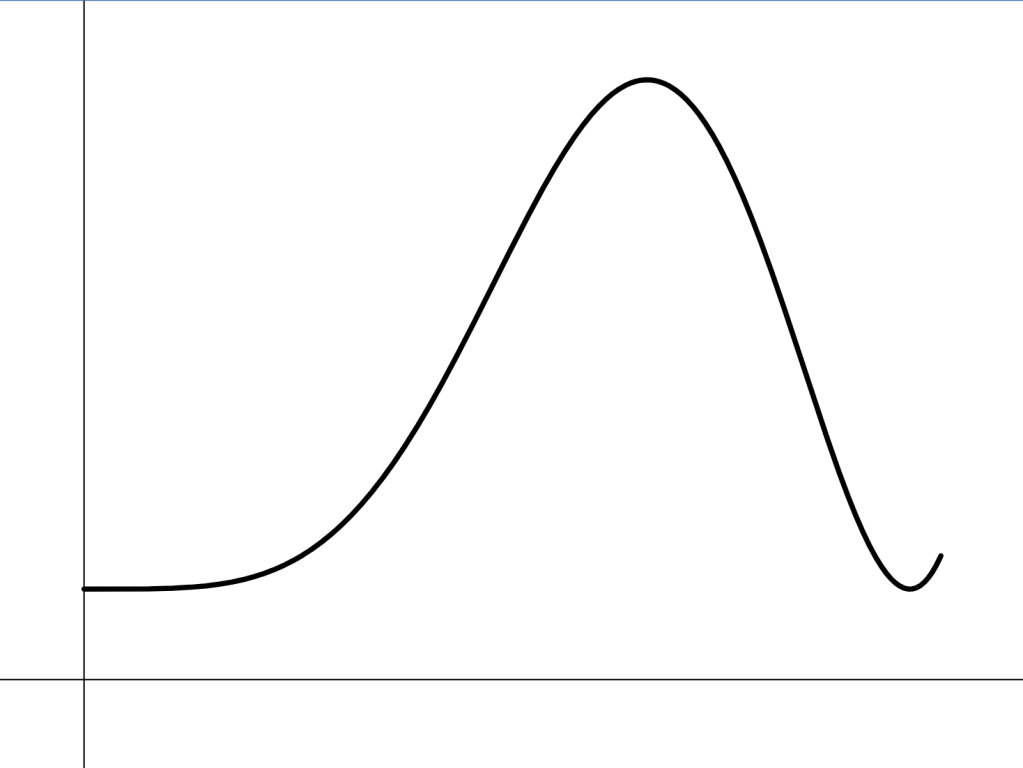
A plot of a continuously differentiable f(x).f(x).
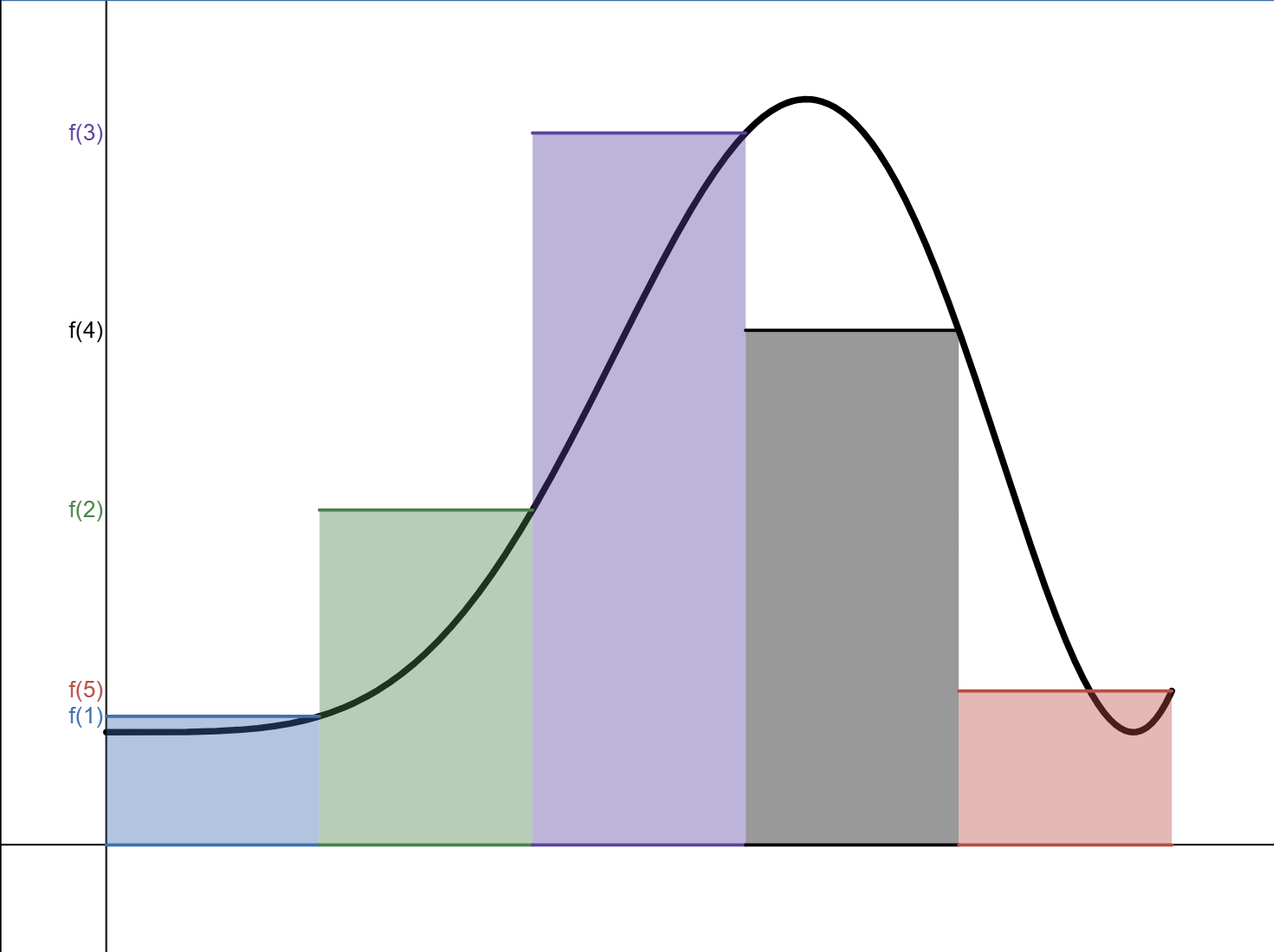
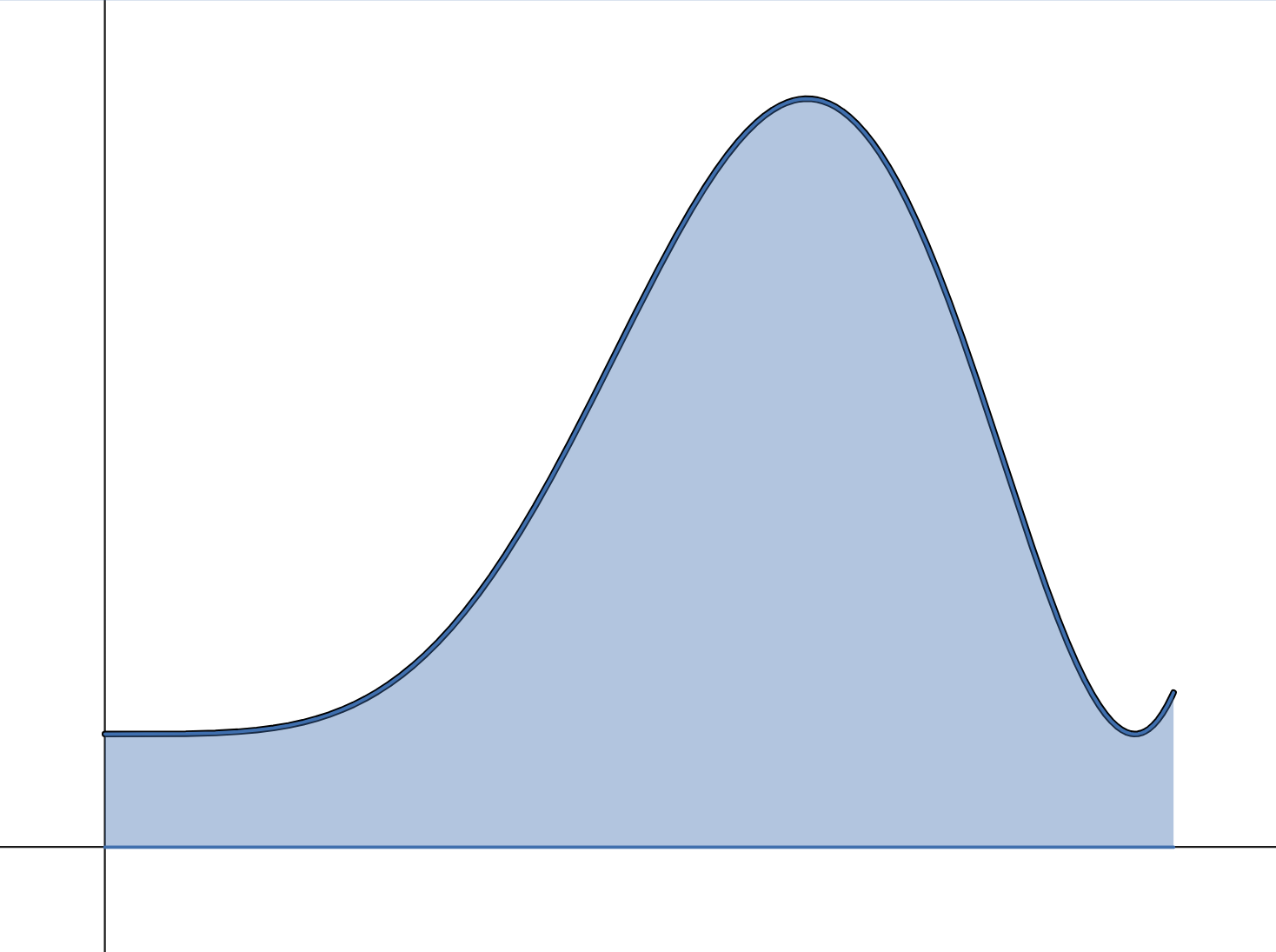
Comparing the finite sum n=mkf(n)\sum_{n = m}^{k} f(n) and the Integral mkf(x)dx,\int_{m}^kf(x)\;dx,
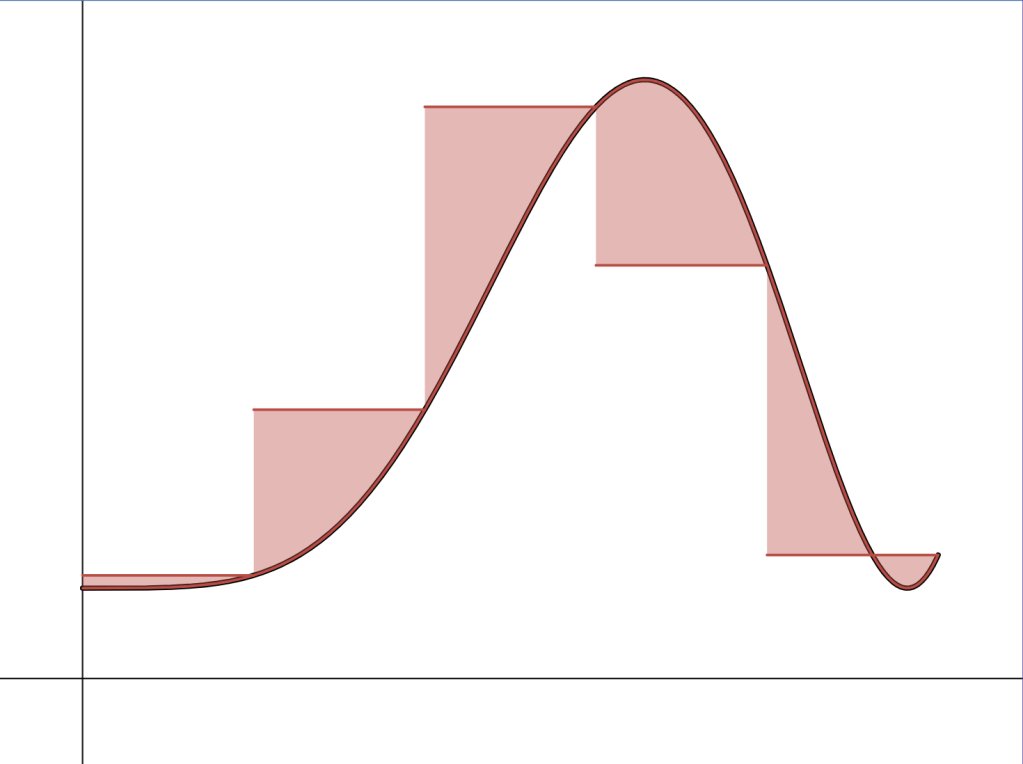
The error n=mkf(n)mkf(x)dx,\sum_{n = m}^{k} f(n) -\int_{m}^kf(x)\;dx,

The easiest way to estimate the error is to focus on the integral between two consecutive integers n1nf(x)dx.\int_{n-1}^{n}f(x)\;dx. This is the idea, although we will find it more fruitful to consider the integral n1nxf(x)dx.\int_{n-1}^{n} \lfloor x \rfloor f\prime (x)\;dx. Let’s get onto the proof, it’s worth all the effort!

Proof: (Click in the Discovery)

To begin, let m:=am:=\lfloor a \rfloor and k:=bk:=\lfloor b \rfloor and let’s first consider the integral n1nxf(x)dx.\int_{n-1}^{n} \lfloor x \rfloor f\prime (x)\;dx. To begin, we note that we can substitute x\lfloor x \rfloor with n1n-1 by noting our bounds of integration. After this substitution, we simply have the integral of f.f\prime. This yields,

n1nxf(x)dx=n1n(n1)f(x)dx=(n1)(f(n)f(n1)).\int_{n-1}^{n} \lfloor x \rfloor \, f\prime (x)\;dx = \int_{n-1}^{n} (n-1) \, f\prime (x)\;dx = (n-1)\Big( f(n) – f(n-1)\Big) .

Which we write more suggestively as,

n1nxf(x)dx=(nf(n)(n1)f(n1))f(n).\int_{n-1}^{n} \lfloor x \rfloor \, f\prime (x)\;dx = \Big(n f(n) – (n-1)f(n-1)\Big) -f(n) .

This is great! Since we want to ultimately find the sum n=m+1kf(n)\sum_{n = m+1}^{k} f(n) we sum the above result from n=m2n=m-2 to n=kn=k and notice that it telsecopes. That is,

n=m+2kn1nxf(x)dx=n=m+2k(nf(n)(n1)f(n1))Telescopingsumn=m+2kf(n),\sum_{n = m+2}^{k} \int_{n-1}^{n} \lfloor x \rfloor \, f\prime (x)\;dx = \underbrace{\sum_{n = m+2}^{k} \Big(n f(n) – (n-1)f(n-1)\Big)}_{\mathrm{Telescoping} \; \mathrm{sum}} – \sum_{n = m+2}^{k}f(n) ,

where first sum on the right-hand side is a telescoping sum. Thus, we end up with

m+1kxf(x)dx=kf(k)(m+1)f(m+1)n=m+2kf(n). \int_{m+1}^{k} \lfloor x \rfloor \, f\prime (x)\;dx = k f(k) – (m+1)f(m+1) – \sum_{n = m+2}^{k}f(n) .

where we used that n=m+2kf(n)=a<nbf(n).\sum_{n = m+2}^{k}f(n) = \sum_{a< n \leq b}f(n). We now solve the above result for a<nbf(n). \sum_{a< n \leq b}f(n).

m+1kxf(x)dx=kf(k)(m+1)f(m+1)a<nbf(n). \int_{m+1}^{k} \lfloor x \rfloor \, f\prime (x)\;dx = k f(k) – (m+1)f(m+1) – \sum_{a<n \leq b}f(n) .

The penultiplate step is to use,

am+1xf(x)dx=af(m+1)af(a)andkbxf(x)dx=kf(b)kf(k)\int_{a}^{m+1} \lfloor x \rfloor \, f\prime (x)\;dx = a f(m+1) – af(a) \qquad\qquad \mathrm{and}\qquad\qquad \int_{k}^{b} \lfloor x \rfloor \, f\prime (x)\;dx =kf(b)-kf(k)

in order to change the bounds of the integral. I.e. we can add and subtract the previous two integrals to the right-hand side of the equation we have for a<nbf(n) \sum_{a< n \leq b}f(n) to have the integral go from aa to b,b,

a<nbf(n)=m+1kxf(x)dx+kf(k)(m+1)f(m+1).\sum_{a<n \leq b}f(n) = – \int_{m+1}^{k} \lfloor x \rfloor \, f\prime (x)\;dx + k f(k) – (m+1)f(m+1) .

We’re almost there. All that is left is to integrate abf(x)dx \int_{a}^{b} f (x)\;dx by parts1 with u=f(x)u = f(x) and v=1v= 1 to show

abf(x)dx(af(a)bf(b)abxf(x)dx)=0. \int_{a}^{b} f (x)\;dx -\Bigg( a f(a) – bf(b) – \int_{a}^{b} xf\prime(x)\;dx\Bigg) = 0 .

Adding this to our pi Euler’s summation formula,ous result we obtainrev

a<nbf(n)=abf(x)dx+ab(xx)dx+f(a)(aa)+f(b)(bb).\sum_{a< n\leq b}^{} f(n) = \int_{a}^{b} f(x)\;dx + \int_{a}^{b} \Big(x – \lfloor x \rfloor \Big)\;dx +f(a) \Big(\lfloor a\rfloor – a\Big) +f(b) \Big(\lfloor b\rfloor – b\Big) .

\square

Oof, that was a lot to take in! But now that we have this awesome tool in our toolkit, let’s apply it to the harmonic series. But there is one bit of notation that we will want to take advantage of. It’s called Big Oh notation (I’m serious). We say that f(x)f(x) is big Oh of g(x)g(x) and write f(x)=O(g(x))f(x) = O(g(x)) when there is some M>0M>0 such that |f(x)|Mg(x)|f(x)|\leq Mg(x) for all xa.x \geq a. That is,

f(x)=O(g(x))a&M>0:|f(x)|Mg(x),xaf(x) = O(g(x)) \iff \exists a \;\And \;\exists M>0 \;:\; |f(x)|\leq Mg(x),\;\;\forall x\geq a

With this, we have the following result.

An Application of Euler’s Summation Formula

Theorem: For x1x\geq 1 we have

nx1n=lnx+γ+O(1x).\sum_{n\leq x} \frac{1}{n} = \ln{x}+\gamma + O\left(\frac{1}{x}\right).

We interpret the sum n\sum_{n\leq } as n=1x.\sum_{n=1}^{\lfloor x\rfloor}.

Proof: (Click in the Discovery)

Let x1x\geq 1 and let’s use Euler’s summation formula with f(n)=1n,a=1,b=x.f(n) = \frac{1}{n},\; a=1,\;b=x. Note, that f(t)=1t2,f\prime (t) = -\frac{1}{t^2}, and thus

1<nx1n=1x1tdt1x(tt)1t2dt+1x(xx)11(11).\sum_{1< n\leq x}^{} \frac{1}{n} = \int_{1}^{x} \frac{1}{t} \;dt – \int_{1}^{x} \Big(t – \lfloor t \rfloor \Big)\frac{1}{t^2} \;dt +\frac{1}{x} \Big(\lfloor x\rfloor – x\Big) – \frac{1}{1} \Big(\lfloor 1\rfloor – 1\Big) .

Note that the first integral is equal to ln<!– is O(1x).O\left(\frac{1}{x}\right). The fourth term is equal to mspace>x.\ln{x}. Let’s come back to the second integral. The third term is bounded by |xxx|1x.\left|\frac{\lfloor x\rfloor – x}{x}\right| \leq \frac{1}{x}. Thus, the third term

Shifting our attention to the second integral on the right hand side, we see that

1xttt2dt=1ttt2dtxttt2dt.\int_{1}^{x} \frac{t – \lfloor t \rfloor }{t^2} \;dt = \int_{1}^{\infty} \frac{t – \lfloor t \rfloor }{t^2} \;dt – \int_{x}^{\infty} \frac{t – \lfloor t \rfloor }{t^2} \;dt .

Note that we can make sense of the improper integral since the integrand is bounded above since ttt21t2.\frac{t – \lfloor t\rfloor}{t^2} \leq \frac{1}{t^2}. In partucular we have the following two results,

01ttt2dt11t2dt=lims(1s+1)=1.0\leq \int_{1}^{\infty} \frac{t – \lfloor t \rfloor }{t^2} \;dt \leq\int_{1}^{\infty} \frac{1}{t^2} \;dt = \lim_{s\rightarrow \infty} \Big(-\frac{1}{s}+1\Big) = 1 .

and

0xttt2dtx1t2dt=lims(1s+1x)=1x.0\leq \int_{x}^{\infty} \frac{t – \lfloor t \rfloor }{t^2} \;dt \leq\int_{x}^{\infty} \frac{1}{t^2} \;dt = \lim_{s\rightarrow \infty} \Big(-\frac{1}{s}+\frac{1}{x}\Big) = \frac{1}{x} .

So the improper integrals exist, and what we wrote makes sense. Furthermore, the integral above is also O(1x).O\left(\frac{1}{x}\right). Combing this with what we remarked eariler we have

n=1x1n=lnx+11ttt2dt+O(1x),\sum_{ n=1}^{\lfloor x\rfloor} \frac{1}{n} = \ln{x} +1 – \int_{1}^{\infty} \frac{t – \lfloor t \rfloor }{t^2} \;dt +O\left(\frac{1}{x}\right),

where we get the + 1 from adding 1 to both sides in order to have our sum on the left-hand side start at 1. Now, all we must do is show that γ=1tt2dt.\gamma =\int_{1}^{\infty} \frac{\lfloor t \rfloor }{t^2} \;dt . This can be seen quickly by

11ttt2dt=lnxn=1x1n+O(1x).1 – \int_{1}^{\infty} \frac{t – \lfloor t \rfloor }{t^2} \;dt = \ln{x} – \sum_{ n=1}^{\lfloor x\rfloor} \frac{1}{n} +O\left(\frac{1}{x}\right).

Then, letting xx\rightarrow \infty the right and side becomes γ+0.\gamma + 0.

\square

Mystererious γ\gamma

Euler’s constant γ\gamma all over the place in analytic number theory. It has been said that γ\gamma is the third most important constant behind only π\pi and e.e. However, there is a lot that is unknown about γ\gamma that is known about π\pi and e.e. For instance, we do not yet know if γ\gamma is rational or irrational! However, we know that π\pi and ee are both irrational numbers. We know even more about π\pi and e,e, we know that they are both transcendental. This makes understanding γ\gamma a great unsolved mystery of analytic number theory. This makes γ\gamma one of my favorite numbers.

I hope that you have had some fun and are maybe motivated to prove whether or not γ\gamma is rational or irrational! If you do, please put a link to your paper in the comments!

Be Kind. Be Curious. Be Compassionate. Be Creative.

And Have Fun!


Footnotes:

  1. Roses are red,
    violets are blue,
    udv=uvvdu.\int u dv = uv – \int v du. ↩︎

Leave a comment