
Happy Star Wars Day, everyone, and May the Fourth be with you! Today, we will discuss a little physics. In particular, we will look at some of the fundamentals of classical physics: Newton’s three laws of motion. We will not go through the history of these laws and how they don’t all originate with Newton; instead, we will try to build a foundation of intuition for what these laws aim to capture. While doing this, we introduce some math(s) to keep us honest with what our physical laws tell us will happen! With this said, let’s begin with a thought experiment!
Thought Experiment
This is meant to spark curiosity in the following material and highlight what concepts you might want to focus on. It is not meant to be stressful or aggravating. So, if you enjoy this type of stuff, give it a go!
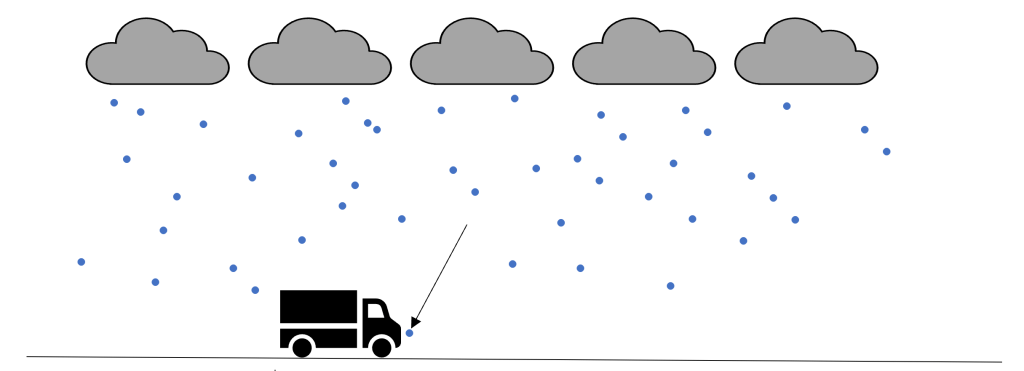
Picture a raindrop falling down from the sky, meanwhile a giant truck is barreling down the freeway, see the image below. The raindrop, while in mid-air, gets hit by the truck. The question is which, the truck or the water drop, felt a greater force from the impact? (You can assume, if you want to, that the raindrop is actually a piece of invincible hail, so it won’t break on impact)
The Three Laws of Motion
Finally, we will learn about Newton’s Laws of Motion; however, these laws are not all original to Newton, e.g., the first law comes from Galileo Galilei, but enough of my stalling… here they are!
Law 1: An object that has no net force acting on it will coast at a uniform speed in a straight line path, i.e., the object will maintain a constant velocity (velocity equal to zero is also a constant velocity). This constant velocity is the object’s natural state of motion. (I am borrowing terminology from general relativity, in particular that `natural’ means no forces.}
Law 2: When an object has a non-zero acceleration, there is a non-zero net force that acts on the object in the same direction as the acceleration vector to cause the acceleration. Again, the vectors and point in the same direction. Furthermore, for a given force, the resulting acceleration is inversely proportional to the amount of `stuff’ (or matter ) the object is made of (a larger object will require a larger net force in order to achieve a desired acceleration).
Summing up Law 2, we get the following three mathy statements:
Combining the three statements above results in one of the most famous physics equations,1
Law 3: For every force there is a corresponding force that is equal in magnitude but points in the opposite direction. That is,
where
Don’t worry about the `12′ or `21′ in the subscripts. This is just notation; all that it is meant to convey is that is a force that object 1 applies to object 2, and is the force that object 2 applies to object 1.
Almost everything you can think of can be explained classically by these “simple” laws!2 These three laws are known as Newton’s Laws of Motion. Notice that all these laws deal with forces and their characteristics. Interestingly enough, these laws are, for the most part, still valid in Einstein’s Relativity, but with a little fine-tuning.
Reference Frames and the Relativity Principle
The laws of motion, as they’re stated above, are valid in every inertial reference frame (if you haven’t learned what an inertial frame is, don’t worry, we discuss this in the next section), and on top of that, each of these inertial frames is as good as any other; however, some will be harder to work with than others. The previous sentence is so profound that it will be repeated, but this time in bold for extra emphasis:
The laws of physics work the same way in every inertial reference frame!
This is called The Relativity Principle, and it is one of the foundations of Einstein’s theories of Special and General Relativity, yah… it’s that important! Let’s discuss this phrase and its consequences in more detail.
Forces and Inertial Frames
Since we can use any inertial frame, our first goal is to find the simplest frame we can work with. However, finding the simplest possible frame is sometimes very difficult, and we might not have time to determine which frame is best. But, the good news is that even if we can’t find the easiest frame, we don’t need to worry because whichever inertial frame we choose, easy to work with or not, will give us the correct answer. This part takes experience to get on the first try. The best advice I can give, besides just solving many different problems, is to think through what you expect to happen before you start analyzing it. This needs to be both conceptual and slightly mathematical. Conceptual because we need to get a general picture of what we think will happen, and mathematical so that we can apply some analysis to the type of motion that we expect to happen, e.g., circular motion, straight line motion, etc.
An inertial frame is a non-accelerating perspective from which you are viewing your system. Consider the analogy of looking at a movie on your phone screen. The perspective you have while watching the movie is the same as the camera’s perspective. We call this perspective of the world your frame of reference. The only question you need to ask and answer now is: “Was the camera accelerating?” If you answer with an enthusiastic “No!”, then the frame you are using is an inertial one. However, this camera doesn’t need to be at rest as long as it moves with a uniform velocity. For example, imagine that we are in a train moving at a constant speed in a straight line. If we look out a window and see someone playing catch on the platform, our perspective from inside the train is inertial.3
We know what an inertial (non-accelerating) frame is, and Law 2, we want to combine these ideas. First, non-accelerative means that the acceleration of the frame is equal to zero, From Law 2, we deduce that the net force on the frame is zero too, This begs the question: What does represent? This is best answered by an example.
Consider being on a merry-go-round. When it’s spinning around and around you are holding tightly onto a pole to stay on. This means, you are applying some force to keep your perspective on the spinning merry-go-round. For this reason, we say that your merry-go-round frame has a non-zero net force and therefore a nonzero acceleration. Consequently, this frame is not inertial.
There are a lot of interesting consequences that happen when we’re not in an inertial frame. For example, let’s go back to being on the spinning merry-go-round. Suppose that we decide to toss a ball towards the center of the merry-go-round. When we throw the ball towards the center, we would think that it should head towards the center. However, this isn’t the case! The ball will appear to deflect for some strange reason! I encourage you to try to picture what happens. Or, you can Google it to see what GIFs come up!
This weird motion of the ball could lead us to conclude that it was accelerating. This would then mean, using Law 2, there was a force acting on the ball in the direction of the deflection! But we know that had someone else looked at the ball that was not on the merry-go-round, they would not have seen the ball’s motion and said that it was deflecting. They would not have concluded that this fictitious force existed.
The force that we would have associated with the ball’s apparent acceleration comes from the fact that we are spinning around, and we’re not in an inertial frame. And, since the force was not really there, it’s fictitious; it only showed up because we are accelerating and applied our analysis from a non-inertial frame. If it were, how could we tell whether an object was accelerating because of our perspective or because a force was actually acting on it?
Summing up what we said about non-inertial frames having zero net forces acting on them we have,
Note that we did not care about the mass of anything. We only cared about the acceleration.
A quick note on units. Mass is measured in kilograms and is written as The units of acceleration are meters per second per second (or meters per second squared) Thus, the unit of force is kilogram meters per second per second, But, writing all the time is cumbersome, especially when working with forces a lot, so a new unit was invented. The unit is called a Newton and is equal to one kilogram meter per second squared
This is the unit we will be using primarily for forces. However, so you have a small understanding Newtons compare to pounds we have that So one pound is about four and a half Newtons.
Consequences of The Relativity Principle
The Relativity Principle states that you cannot distinguish whether you are standing still or moving with constant velocity. Remember, velocity deals with speed and direction, therefore, in order to have constant velocity, you need a constant speed and a travel in a constant direction. To recap what we said a moment ago:
You cannot distinguish between: an inertial frame that is
moving at a constant velocity and an inertial frame that is at rest, using the laws of physics.
or even better yet,
You cannot state that any inertial frame is the “correct” frame using the laws of physics.
As an illustration, imagine we are playing catch on a train or in a plane (this sounds like the beginning of a children’s book). The windows are covered, so we can’t see whether the train or plane is moving. We happened to fall asleep, and we don’t know when or if the train/plane might have started moving. What the relativity principle states is that if we were performing science experiments on the train/plane, we wouldn’t notice any difference in the results whether or not we were moving. For a concrete example, we could be playing catch and we would play the same way whether or not the train/plane had taken off already. We would not be able to definitively say if we were moving or not! So, from our perspective, we could say either that we were at rest or that we were moving —both are correct statements.
This is a profound principle, and we will use this principle many times; in energy, special relativity, magnetism, etc.4
Wow That Was A Lot
This section was short but dense, and it’s best to review the concepts covered once more. We are going to bring the two profound statements that we discussed above together;
The laws of physics work the same way in every inertial reference frame, and therefore, you cannot distinguish between an inertial frame that is moving at a constant velocity and an inertial frame that is at rest using the laws of physics.
These together tell us that we can choose any frame that’s inertial to work with. How lucky are we? If we can find a frame that is really easy to work with, then we have just made your life much easier. However, if you are struggling to find a good frame to use, you don’t need to worry too much; you just need to work the problem all the way through.
One Last Note on Choosing A Frame
Although it’s true that we can use any inertial frame and any consistent choice of units, our choice of an inertial frame can change the exact numbers that we use to quantify what happens. It’s similar to how the numbers we use to describe an American football field’s size is 100 yards or 300 feet. The number changes, but the physical size of the field does not! In other words, our description is the same: 100 yards = 300 feet.
A similar thing can happen to our equations. Our vectors’ components might have different numbers, but the relationships between vectors will be the same. An example that you may have seen before is choosing our initial and final locations. We can choose any place to say is at zero height. Choosing the zero height on the ground might mean that the initial height of our ball is equal to However, choosing the zero height to be at the level of our table will give an initial height of our ball to be Then, using our frames, locate the final position of the ball: or Again, the values may not be the same— or —but the difference in them will be the same, This is great, since a lot of our equations care only about changes in quantities.
Mass and Inertia
Before we go on to tackle what a force is, let’s first make a few remarks on what I meant by `stuff’ things are made of in Law 2. What `stuff‘ translates to, for us, is mass. Therefore, Law 2 states that: acceleration of an object is inversely proportional to the mass of a given object for a given force. I.e., the more massive the object, the smaller the acceleration it will undergo when a fixed force is applied to it. Great! But… what exactly does mass mean?
Option (1): The first and simplest definition of mass is that it is a measurement of the amount of stuff things are made of. Things that are made of more material are more massive. A truck is more massive than a raindrop. A word of caution: mass is not the same as weight; weight is a force and is different depending on what gravitational field you are in, while mass does not change. A car weighs about on Earth, weightless in orbit, and only on the moon! The mass of the car (the amount of stuff that makes it up) is the same everywhere! Whether it’s on the moon, in orbit, or on the Earth the mass is The unit we use to describe mass is the kilogram,
We haven’t even mentioned that everything with mass is made of atoms. We can roughly think of mass as measuring how many atoms something is made of. This is not the full picture, though. Some atoms are more massive than others because of the way they are formed with protons and neutrons. This would then lead us to the concept of density. For the same number of atoms, something made of gold is more massive than something made with water.( Don’t worry about density just yet. We only need to know about mass.)
Now, it would be weird to think that just by being on the moon or Earth, you would gain or lose atoms.6
Summed up: mass is the amount of stuff that makes up the object.
Option (2): The second definition of mass is: the way we measure how much inertia something has. That’s great, but now we swapped one term we were unfamiliar with for another term we are unfamiliar with. So, what is inertia? Inertia is `how much’ an object `wants to’ not change its current motion.
What is meant by `wants to’? This is best answered with an example. Picture a frictionless surface with two masses sliding across it, with one larger than the other For concreteness, let’s say (like a water bottle) and (like a truck). They are both sliding with constant velocity, ie equal to You want to slow them both down, one at a time. Intuition tells us that the water bottle is easier to stop than the truck, but why? From Law 1, we know in order to stop them, we need to apply a force to de-accelerate them (de-accelerating is accelerating in the opposite direction of the velocity), and we know from Law 2, that for the two masses to have the same acceleration the larger mass will require a larger force. Therefore, the truck requires more force in order to stop it (for the same acceleration), and because of this, we say that the truck will resist the change in velocity more than the water bottle. This is what we mean when we speak of inertia.
From only the concept of inertia, we can answer questions like, “Why does a giant truck accelerate so much more slowly when you are driving it when compared to a standard car?” It’s because the larger truck is more massive and will not want to speed up as quickly as a standard car does. Another question we can answer is, if you have ever gone bowling, why does the bowling ball seem to want to roll on forever after you release the ball?” The reason is that the ball has inertia and wants to keep moving in that straight line with the same speed forever (the lack of substantial friction helps us to see that the ball will try to keep going).
Inertia is responsible for the reason why force is not needed to maintain motion. A mass will just coast until something (a force) stops or redirects it. This is a very important concept to keep in mind for when we start to use “free body diagrams” to analyze different situations.
Summed up: Mass measures inertia and inertia measures how much an object wants to not change what it’s doing.
Option (3): The last definition (the `most’ correct one) is that mass has the property of inertia and is directly related to the energy content of the object, i.e., mass and energy are two sides of the same coin. This is a consequence of Everything with mass has energy, but everything with energy does not have mass (like light).
One last property that is not a definition of mass but comes from mass is, that mass is responsible for the ability for things to come to rest in some frame. Take, for instance, light’s particles, photons, which have zero mass and cannot be brought to rest. Light will always travel at the speed of light in a vacuum.
Summed up:
What is a Force?
It seems that all these laws deal with changing motion and forces. This is correct. Why do we care about changing motion so much? One answer is that the world is full of change, and we could not describe motion without introducing how things interact and change. In interactions, forces arise, and these concepts then show up out of necessity. Long story short, to accurately describe nature as we see it, we need to be able to recognize accelerations that are due to forces.
Before we define what a force is, let’s list some examples of what we call forces. We seem to call gravity a force, as well as friction forces, and when you are in your car, we say the car pushes (forces) you faster when you hit the gas. If we find what these have in common, we might be able to define what a force is. Take a moment to see what you come up with.
Let’s go through some of what you might have noticed.
They all seem to deal with acceleration, so we could define a force as something that causes an acceleration. This would be using Law 2 then, as our definition.
Not quite, we will run in to confusions if we define a force just like this. For example, you are presumably sitting reading this, do you feel the ground or chair pushing on you, or do you feel the pressure (which is related to force) of the seat or floor under you? Yes, you should unless you are floating, haha. The force we are feeling is what we call normal force—don’t worry about the name right now. Right now, you are being pushed up by the ground, and yet you are not accelerating, so with our original definition, we would not call this a force even though it is. Or, if you are not convinced that the ground or chair is pushing on you, what if you go up to a wall (try this if you want) and push on it? You are clearly applying a force to the wall, but the wall is not accelerating! We run into the same problem as before: there’s no acceleration. But acceleration does seem to play some role in all this. I mean, look at Law 2!
So what is a force, exactly?
The truth is, there is no exact definition of force.7 Aside: This doesn’t sound good for physics! Isn’t physics/science supposed to be able to explain nature exactly, with everything based on definitions or first principles? No, I would argue the goal in physics is to try to explain nature as accurately as possible, no more, no less. Every theory or law that we have is, at some level, only an approximation of the truth—whatever that means—with some better and more accurate than others, but they are still just approximations. So, all we can say is that a nice way to picture what a classical force is:
A force has an origin or cause, and by itself, would cause an acceleration in accordance to Newton’s Laws.
This “definition” has two components: First, a force must have an origin, and second, a force would, if acting alone, cause an object to accelerate.
Let’s take gravity as our first example. What’s its origin? For now, we will take its origin to be all mass. How about friction? Its origin, like for your push on the wall, the car’s push, and the normal force we mentioned before, is contact. Now, the examples with an accelerated motion deal with a change in its natural state of motion by definition. What about the `problem’ examples from before? When you push on the wall, the force you are applying should cause the wall to accelerate, but it doesn’t. Why? Your force must not be the only one acting on it. This is why it was a problem; we did not consider the possibility of multiple forces. If your push was the only one acting on the wall, it would accelerate!
Note though, that we did not define a force to be In other words, we did not define what a force is using only Newton’s Second Law. This is important to notice because, if we didn’t, then we wouldn’t learn anything!
If we only know that a force causes an acceleration, then we can only say when a force is present or not, and we learn nothing about the dynamics. What we need is the notion of a force outside of Newton’s laws. This is when we can learn something.
Let’s look at gravity again. We have, from Newton, that is proportional to mass and of the two objects—or for now we can say that for objects close to the Earth. This is then connected to the dynamics of the objects through We need an outside notion of the strength of the force and then to connect it to the dynamics. There are two pieces needed here. Most of classical physics’ goal is to introduce different types of forces and then connect them to By doing so, we learn about the force’s origin and how it changes the motion of something of interest.
Law 3
We indirectly just talked about Law 1 and Law 2. So we are going to dedicate this section to Law 3.
The third law states that for every force, there is an equal and opposite force that acts on it. This law is like a universal non-optional two-for-one sale on forces! By equal and opposite we mean equal in magnitude and opposite in direction.
For example, if you are hitting a heavy bag, the heavy bag hits you back with the same amount of force! If we label your boxing glove as object 1 and the bag as object 2 we would write the force applied from 1 on 2 as and the force from 2 on 1 as, With this notation, we would come to the conclusion that: and this will always be the case.
Now, let’s look back at the thought experiment from this chapter in Section Thought Experiment. The car hits the water drop with some force, , and from Newton’s Third law, the water drop hits the car with a force, These two forces act with the same magnitude! Both get the same amount of force!
This is true even though it seems that the water gets hit harder than the truck does. The reason why it seems like this is because the water drop changes it motion, by accelerating, more than the truck. The raindrop is less massive and accelerates more, while the truck is more massive and accelerates less.
How much more does the drop accelerate?
We can use what we know from Law 2 to find out,
and we can get the ratio,
If we assume that the drop of water is 1 gram, and the truck is the ratio becomes,
We deduce that the water drop accelerates 10 million times faster than the truck. However, the same amount of force acts on each of them, Law 3, but because the truck is 10 million times more massive, it goes unnoticed!
Hope You Had Fun!
Today we learned some awesome physics! I had a lot of fun writing this, and I hope that you learned something or at least enjoyed it. This was inspired by the fact that today is May the Fourth be with you day. I don’t have much more to talk about, so, see you next time!
Oh, wait one comment. If you want to learn some special relativity check out: Time Dilation Through the Geometry of Right Triangles.
Be Kind. Be Curious. Be Compassionate. Be Creative.
And Have Fun!
- May the mass times acceleration be with you! ↩︎
- That does not deal with electric, magnetic, or nuclear forces. ↩︎
- A wall walks into a man, oops wrong reference frame!! ↩︎
- Interestingly, one phenomenon of magnetism that did not seem to fit this principle actually helped lead Einstein to special relativity when he believed so much in this principle that he gave up on universal space and time! ↩︎
- ↩︎
- A force in classical and relativistic physics is different than that a “force” in quantum theory, whatever that means. ↩︎


Leave a Reply