
Preamble (Feel free to skip)
There are many times (at least in school) where we need some random trigonometric identity to be able to solve a problem. At least for me, I’ve never bothered to memorize the double angle formula or the sum of angles formulae! I’m guessing most of you are in a similar boat to me. It seems to be a trend that people who enjoy math enjoy it because they can be lazy efficient with what they need to memorize. Also, I’ve been in a few conversations with friends and fellow math enthusiasts where I found out they were unfamiliar with some tricks you can perform using Euler’s formula in regard to deducing trigonometry identities. This cannot stand! It’s too wonderful and simple (compared to the geometry proofs) to derive complicated trigonometry identities using Euler’s formula to not tell you about!
Euler’s Formula
Considered by many to be the most beautiful math equation of all time, I would not be surprised if a few of you have already come across Euler’s formula. But, to make sure we are all up to speed here it is,

Deceptively simple, it gives us a remarkably easy way to work with complex numbers. That’s for another day however, today all we need to know is that 


For example, 
Sin(a+b)=? and Cos(a+b)=?
Using Euler’s formula we see,

But, using our exponent product rules we can also equate the above equation with,

Why is this useful? Because we can then use Euler’s formula on 


Which, by foiling out the product we get,

Where we grouped all the real terms into the first parenthesis and the imaginary terms into the second set of parentheses. Using our very first expression for 

Recall that two complex numbers are equal if and only if the real parts are equal:

and the imaginary parts are equal:

Just like that we figured out what the sum of angles formula are for sine and cosine! We didn’t even need to draw a single triangle! How amazing is this! Even though I love triangles and geometry, I still find it immensely pleasing that this works at all!
Cos(a)Cos(b)
We are going to use a slightly different strategy. First, consider 

Recalling that 


Vocabulary Alert: For some complex number 


Question, what is the sum of 


How wonderful! Solving for cosine we get,

In some way, we could use this equation to define the cosine function without appealing to any triangles (again!).
Let’s use our newfound expression for cosine to find 

With a little rearranging we deduce,

Just like that, we have it! Not too bad huh? This is what I use whenever I need to use some trig identity that I haven’t memorized, yet. It’s fast, and when you get used to it you can skip lots of algebra steps making it quicker!
Just to make sure you can easily find the result if you come back to the article,

Sin(a)Sin(b)
You can use the exact same logical steps to deduce the product formula for sine. We just need to find a formula for sine in terms of complex exponentials (like 
We have 


Thus, 

The algebra will be a little messier than it was for cosine, because of the extra minus sign and the

And just like that,

Pythagorean Theorem
We’ve already considered the sum and difference of 

You’re probably familiar with the Pythagorean theorem and how it relates the side lengths of a right triangle. Euler’s formula allows for a quick “proof”, of sorts, of the Pythagorean theorem. It’s time to take the product of

Furthermore, using Euler’s formula,

Thus,

Which is the unit circle version of the Pythagorean theorem. How wonderful yet again!
Demoivre’s Theorem
Most people have not heard of Demoivre’s Theorem but it’s also a great theorem regarding complex numbers. Before we state what, it tells us, let us first mention polar form for complex numbers.
Let

Above we plotted four complex numbers. The way we did so was by taking 


Picture a circle centered at the origin that is large enough so that way 


For example, 


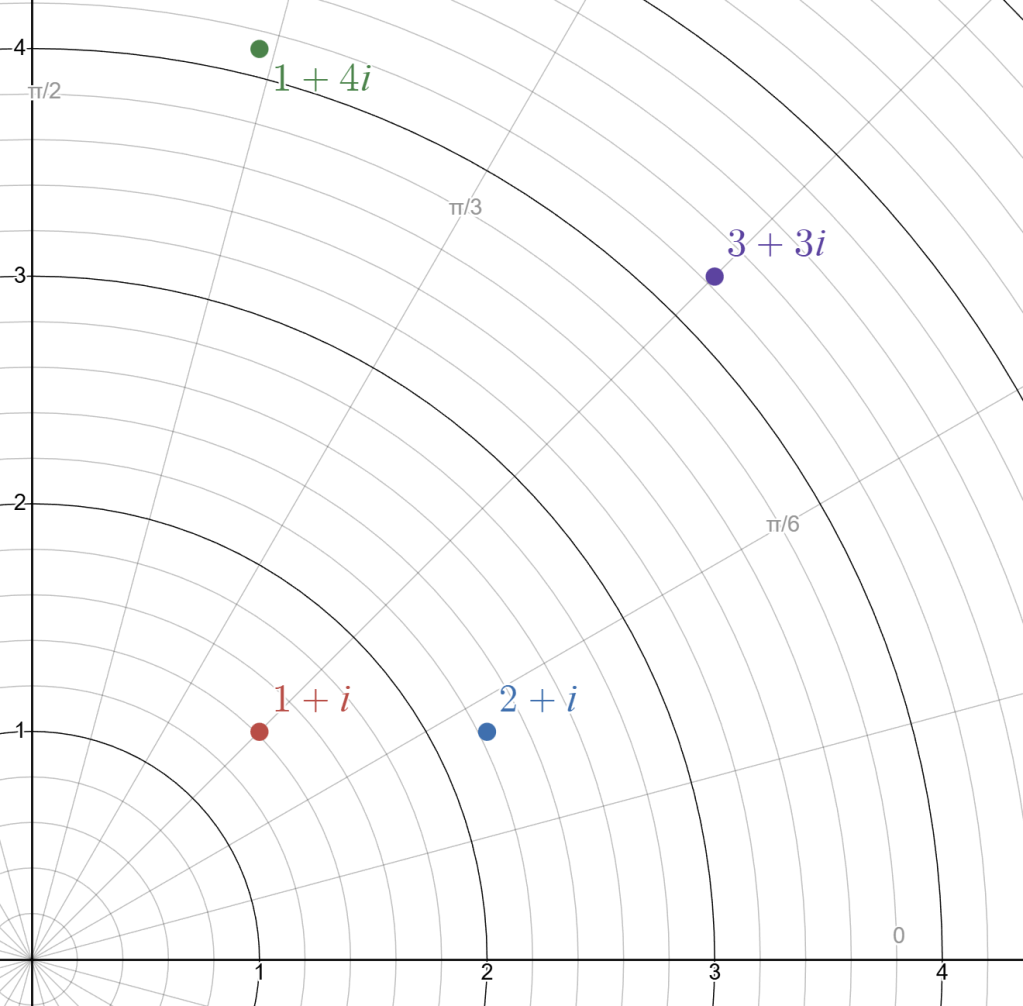
We are therefore led to the following conclusion:

where 

Now imagine the situation where you wanted to raise some complex number to a large power 

![\Bigg[ r \,\Big( \cos{(\theta)} + i \sin{(\theta)}\Big) \Bigg]^n = r^n \,\Big(\cos{(n\theta)} + i \sin{(n\theta)} \Big)](https://s0.wp.com/latex.php?latex=%5CBigg%5B+r+%5C%2C%5CBig%28+%5Ccos%7B%28%5Ctheta%29%7D+%2B+i+%5Csin%7B%28%5Ctheta%29%7D%5CBig%29+%5CBigg%5D%5En+%3D+r%5En+%5C%2C%5CBig%28%5Ccos%7B%28n%5Ctheta%29%7D+%2B+i+%5Csin%7B%28n%5Ctheta%29%7D+%5CBig%29&bg=ffffff&fg=000&s=0&c=20201002)
The usual proof uses induction and requires some comfort with trig. But, using Euler’s formula it is a one-line proof!
![\Bigg[ r \,\Big( \cos{(\theta)} + i \sin{(\theta)}\Big) \Bigg]^n =\Big(r e^{i\theta}\Big)^n = r^n e^{in\theta}= r^n \,\Big(\cos{(n\theta)} + i \sin{(n\theta)} \Big)](https://s0.wp.com/latex.php?latex=%5CBigg%5B+r+%5C%2C%5CBig%28+%5Ccos%7B%28%5Ctheta%29%7D+%2B+i+%5Csin%7B%28%5Ctheta%29%7D%5CBig%29+%5CBigg%5D%5En+%3D%5CBig%28r+e%5E%7Bi%5Ctheta%7D%5CBig%29%5En+%3D+r%5En+e%5E%7Bin%5Ctheta%7D%3D+r%5En+%5C%2C%5CBig%28%5Ccos%7B%28n%5Ctheta%29%7D+%2B+i+%5Csin%7B%28n%5Ctheta%29%7D+%5CBig%29&bg=ffffff&fg=000&s=0&c=20201002)
BOOOM!
Concluding Remarks
Euler’s formula is a critical tool for complex analysis, algebra, and basically anything you want to do that needs complex numbers. Not only this, it also leads to the most beautiful equation ever, called Euler’s Identity:

Which brings together 


There are numerous sources out there to learn more about complex numbers and how useful they are. However, using it as a tool for fast trigonometry is useful for anyone and not just those who study complex numbers!
For those who want more information about complex numbers feel free to peruse these sources. As always, I hope you have a kick in the discovery along the way!
Further Fun for the Fundamentals
- Veritasium’s (Video): How Imaginary Numbers Were Invented
- Numberphile (Video): Euler’s Formula
- Brillant (Article): Polar Coordinates | Brilliant Math & Science Wiki
- Numberphile (Video): Complex Numbers are Awesome
- Numberphile (Video): e (Euler’s Number)
- 3Blue1Brown (Video): What’s so special about Euler’s number e? | Chapter 5, Essence of calculus
- 3Blue1Brown (Video): Complex number fundamentals | Ep. 3 Lockdown live math
- 3Blue1Brown (Video): What is Euler’s formula actually saying? | Ep. 4 Lockdown live math
- Khan Academy (Video and Problems): Complex numbers | Algebra 2 | Math | Khan Academy
- Stan Up Maths(Video): Complex Fibonacci Numbers?
Awesome and Advanced
- Textbook: Complex Analysis (Princeton Lectures in Analysis, No. 2): Stein, Elias M., Shakarchi, Rami: 9780691113852: Amazon.com: Books
- MIT’s OCW Syllabus | Complex Variables with Applications | Mathematics | MIT OpenCourseWare
Footnotes:
- Let
you get the complex conjugate denoted by
or
by simply changing the sign on the imaginary part. Some examples are the following:
.
The reason why people care about the complex conjugate is because of what the product of. Which is a real number and that it looks like the Pythagorean theorem!
↩︎ - Note this angle is not unique since
↩︎


 A Kick in the Discovery
Leave a reply to Trig Rules the Old Fashioned Way – A Kick in the Discovery Cancel reply