
I’ve recently started a new research project that has connections to permutation groups. For this reason, I thought that I would write an article about them so that friends and family could learn a little math regarding what I might be thinking about for the next few months! But you don’t care about that! You just want/need to learn about permutation groups, I mean… you clicked on the link! So, let’s just get into this!
What’s A Permutation?
Loosely speaking, a permutation is a rearrangement of the order of objects (we will focus on a finite list of objects). It doesn’t matter what objects we want to rearrange the order of. For example, when we shuffle playing cards, we are permuting their order. Or, when we make anagrams of a bunch of letters, we are finding permutations of the list of letters. But, since we all love math(s) and numbers, we will focus on permuting (rearranging) the numbers 

![[n]](https://s0.wp.com/latex.php?latex=%5Bn%5D&bg=ffffff&fg=000&s=0&c=20201002)
![[n]:=\{ 1,2,3,\cdots, n\}.](https://s0.wp.com/latex.php?latex=%5Bn%5D%3A%3D%5C%7B+1%2C2%2C3%2C%5Ccdots%2C+n%5C%7D.&bg=ffffff&fg=000&s=0&c=20201002)
Consider the special case of 
![[3]:=\{ 1,2,3\}](https://s0.wp.com/latex.php?latex=%5B3%5D%3A%3D%5C%7B+1%2C2%2C3%5C%7D&bg=ffffff&fg=000&s=0&c=20201002)
Answer: There are 

What we want to do is consider the act of permuting the numbers 1, 2, 3. For example, let 

Or, let 

Yet another example could be letting 

But why stop with only

So, we can combine these actions in some way. Let’s try and apply

But, this is the same as applying 
These operations, these permutations and combinations thereof (
Let’s Make This More Mathy
It’s now time to develop the mathematical machinery. Let’s begin by defining mathematically what we mean by a permutation:
Definition (Permutation): Let 


Great! Therefore, when we want to study permutations, we really are studying bijective functions. But, if all this terminology like injective, surjective, bijective is too abstract for you, then use the loose definition we said earlier: a permutation is a rearrangement of the order of objects. You won’t miss out on anything in this article using the loose definintion.
We are going to study the set of all permutations of 

![[n]](https://s0.wp.com/latex.php?latex=%5Bn%5D+&bg=ffffff&fg=000&s=0&c=20201002)


For example, we know that 


Note, when we write 


It’s a Group!
Recall the definition of a group (and for those who have not seen group theory, don’t worry! We will explain each step)
Definition (Group): Let 


- The operation is associative, i.e.
for all
,
- there is an identity element
where
for all
, and
- for all
such that
.
When the operation is known, we will write that 

We claim that
Theorem (The Permutation Group): The set 
We aren’t going to go through a fully rigorous proof of this fact, but we will explain the thoughts behind each point.
1) Associativity
Since, by definition, a permutation is a bijective function we can use that function compositions are associative to say,
for all 

*Note, it would be more accurate to write 

2) Identity
Recall,

*Note, 
![m\in [n]](https://s0.wp.com/latex.php?latex=m%5Cin+%5Bn%5D&bg=ffffff&fg=000&s=0&c=20201002)
3) Inverses
Since we are permuting our numbers 1 through n, we could always undo what we did to get back to how we started. For instance, 


This is true in general, for any 


*Note, we can do this because bijective functions have inverses.
“

Since 
Two-Line Notation
It’s NOT a Matrix
The easiest way to express some permutation
Let’s begin with the identity we saw already 

Under each of the numbers 1, 2, and 3 we write where

Let’s take another example. Recall

We had

Last, but not least,

One more bit of notation. Since 


Let’s do one more example! Recall the permutation 

Using that

Next, we must swap 2 and 1. Thus, in the bottom row, we swap the 1 under the 3 with a 2, and the 1 goes under the 2:

Not so bad.
If we know where some number

for

How do you Multiply Permutations?
Now that we have a way to write 
What we DO do4 is simply ask, where would # end up after we apply

Note that 

Now, let’s ask where 2 goes. Well, 

Lastly, 

Again, not so bad. Well, not so bad once you get used to it!
Cycle Notation
Mathematicians are lazy efficient people, and they invented an even better method to write down permutations that requires less writing! It has only one line!
What is it?
I will admit, cycle notation can be tricky to get used to, but once you do it will be your best friend when working with permutations. We’ll show how it works through an example. Let’s take the large permutation:

Take a moment to understand what this permutation is telling us. Once you feel ready, keep reading.
We are going to set up the cycle notation for 

and ask, where does 


Now, ask where does 

and then open a new set with the smallest number that we have not used yet. In this case, it’s 3

Where does

Where does 

Where does

What’s the smallest number not used yet? It’s 6.

Since it goes to itself we are done!

When we read a permutation in cycle notation, we read 

Let’s convert
So, we have 1 going to 2, and 2 going to 1. So, we still have

But, again, mathematicians are efficient so when we have a situation when some number does not swap with anything, such as 

One last thing:
Definition: (Cycle) We call a permutation a cycle 


Definition: (Disjoint Cycles) Let 

Then we call 


With these two bits of terminology we’d say that 

How do we combine permutations in Cycle notation?
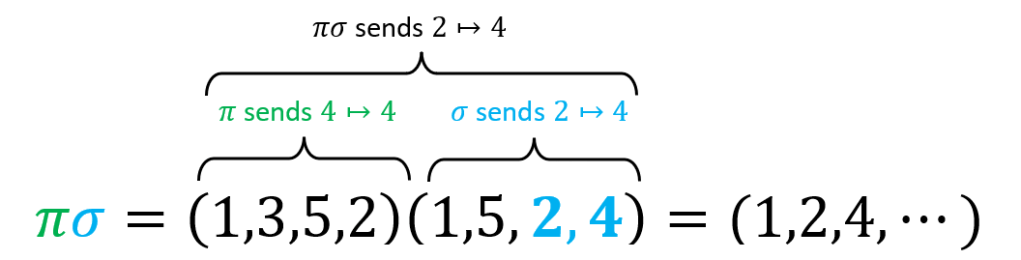
When combining permutations in cycle notation, we basically do the same thing we did earlier. Let’s compute the product of the following permutations:


Where 
Step 1: We begin by determining where 1 will be sent by reading 


Step 2: Begin with 2 now, since in step 1 we found 
Step 3: Continue but now start at 4. See the figure for all the steps!



Transpositions
One interesting property that permutation groups enjoy is that any permutation can be written as a product of 2-cycles. In group theory vernacular,
Definition (Transposition): If 
![a,b \in [n]](https://s0.wp.com/latex.php?latex=a%2Cb+%5Cin+%5Bn%5D&bg=ffffff&fg=000&s=0&c=20201002)

What we said preceding this definition is captured in the following theorem:
Theorem: Every permutation in
Proof: Let 

To check that the above product is indeed the same as the cycle 


Lastly, we note that any permutation can be written as a product of cycles5 and since we can write those cycles as a product of transpositions, we can therefore write any permutation as a product of transpositions.
To see that this product is not unique, consider the products below,

As you can verify (you’re welcome), these are other ways to express

How cool is that! Answer: Very cool!
Even/Odd Permutations
Another reason why we care about transpositions is because we can classify different permutations in terms of how many transpositions they can be written as a product of. For example,

is made up of 5 transpositions, or simply an odd number of transpositions. Or,

is made up of 4 transpositions, or simply an even number of transpositions. Or,

is made up of 3 transpositions, or simply an odd number of transpositions.
Wouldn’t it be nice if we could take some permutation group
It turns out we can! We’ll soon see that no matter how you express, say

Note these products are made up of 5, 5, and 9 transpositions, which are all odd numbers.
Definition (Even/Odd Permutation): Let
Theorem (Even/Odd Permutation Classification): Let
Scratch Work: How should be prove that every permutation is either an even or odd permutation, but not both. Well, we already know the first part: every permutation is either even or odd. This is by the previous theorem. The second part: but not both is where the trickiness lies.
The most obvious line of attack is to assume that some permutation can be both even and odd and try to find a contradiction somewhere. So, let 


where 


So we have found a way to express 


Lemma (The identity is an EVEN permutation): Let 
Proof of Lemma: Let 


First note that if 


Consider when 

Now suppose that 

Consider the last two transpositions in the product for 
![a_1,a_2,a_3,a_4 \in [n]](https://s0.wp.com/latex.php?latex=a_1%2Ca_2%2Ca_3%2Ca_4+%5Cin+%5Bn%5D&bg=ffffff&fg=000&s=0&c=20201002)


Which you can check by multiplying out the transpositions. When the first situation happens, we then have the product 

In the second, third, and fourth situations we have moved


Now we play the same game, focus on the transpositions 


Where ![a_1,b,c,d \in [n]](https://s0.wp.com/latex.php?latex=a_1%2Cb%2Cc%2Cd+%5Cin+%5Bn%5D&bg=ffffff&fg=000&s=0&c=20201002)


This process must come to an end either by resulting in case 1, or by moving
Consider what would happen if we were able to remove

where 


Proof of Theorem (Even/Odd Permutation Classification): Assume for the hope of a contradiction that

where 

We have found a way to express the identity as a product of
We conclude that every permutation is either even or odd and not both.
Theorem (The Alternating Group): The set of even permutations in

is a subgroup of 
Scratch Work: Recall that a subgroup is itself a group and to prove that a subset 
- The identity
- For all
we have
.
- If
then
.
“Proof”: First note that 
- We’ve already showed that the identity is an even permuatioan.
- Let
. Can you explain why
? Hint: let
and
where
- Let
. Can you explain why
?
Closing Remarks
Wow, was this a lot today! But I hope you found it interesting; there is so much more we could discuss! There is Cayley’s Theorem, which teaches us that every group is the same as a group of permutations. Where, the same as, is a loose way to say isomorphic to, for those who know what that means. We can also use permutation groups to show that quintic polynomials are not solvable in general.
Permutation groups are wonderful and tricky! There may be more articles about them in the future, but for now I leave you with a few problems to practice your skills. The solutions are in the footnote.6
Practice
- Write
in cycle notation.
- Write
in cycle notation.
- Write
in cycle notation.
- Is the
and even or odd permutation?
- Is the
and even or odd permutation?
- Is the
and even or odd permutation?
- Is the
and even or odd permutation?
- Can you make a conjecture about when a k-cycle being even or odd permutation? Can you prove it?
- What is the product Is the
?
- What is the product Is the
?
Have fun!
Footnotes:
- Let the function
and
Recall that injective is the fancy math word for one-to-one. Simply put, every element in the range has a unique element in the domain that maps to it. Or, ifthen
. And surjective means that every element in the codomain gets mapped to it. Or, for all
there is some
such that
Lastly, when a function is both injective and surjective, it’s called bijective. So another way of saying that - A binary operation is a rule that takes two inputs and spits out a unique output. For example, multiplication. You take two numbers, say 2 and 10 and multiplication spits out 20. ↩︎
- We can prove the associativity of our permutation products using this: Let
. Then.
↩︎
- Haha do do. ↩︎
- We need to prove that any permutation can be written as a product of cycles, but we can do more. We can prove that any permutation can be written as a product of disjoint cycles. To prove this, let
. Since
for all
we know that the cycle has a finite length. If
has every number in
. Which is again, finite. If every number in
then we’re done. If not, then let
be the smallest number not used. Continue with this process until every number in
. These are all disjoint by construction. ↩︎
- Solutions
1).
2).
3) This is the identityor some people write
.
4)is an even permutation.
5)is an odd permutation.
6)is an even permutation.
7)is an odd permutation,
8) When the k is even the k-cycle is an odd permutation. Can you finish this????
9).
10). ↩︎


 A Kick in the Discovery
Leave a reply to Interesting Group Isomorphisms – A Kick in the Discovery Cancel reply