It’s time! For long time readers, you might recall that we first mentioned the monotone convergence theorem wayyy back in December of 2024 in the article, “Incredibly Serious, Inductive Sequences“. It’s now time to tackle this once and for all! Oh, and by no means do you have to read “Incredibly Serious, Inductive Sequences” before or after you read this article. But you should read it… at some point…

Intuition

We’ve studied what it means for a sequence to converge to a limit, we learned that this limit is unique, and we now have the squeeze theorem as a tool in the tool kit. What is there left to study? (A lot!)

For instance, can we ever prove that a sequence must converge without needing to know or find its limit beforehand? Up until now, we’ve needed to know the limit of a sequence in order to prove that the sequence converged. So, you might think that we’d need to know the value of the limit before we can prove convergence; however, you CAN prove a sequence converges without needing to know the value of the limit. Now, this article won’t give the full story, for that we need to learn about Cauchy Sequences. But we will answer the questioned for what are known as monotone sequences.


Definition: A monotone increasing sequence is a sequence that has the property a_{n+1}\geq a_n for all n\in\mathbb{N}. Similarly, a monotone decreasing sequence is a sequence that has the property a_{n+1}\leq a_n for all n\in\mathbb{N}.


Because monotone sequences are special (since we know that they always increase/decrease/stay the same) we can prove some very precise statements regarding their limits.

Let’s try to deduce what they are. Let’s focus on the monotone increasing case.

Unbounded

Well, if (a_n) is monotone increasing and unbounded above, then it’s probably not surprising that (a_n) can shoot of to infinity. That’s what we mean by unbounded and monotone increasing!

Bounded (above)

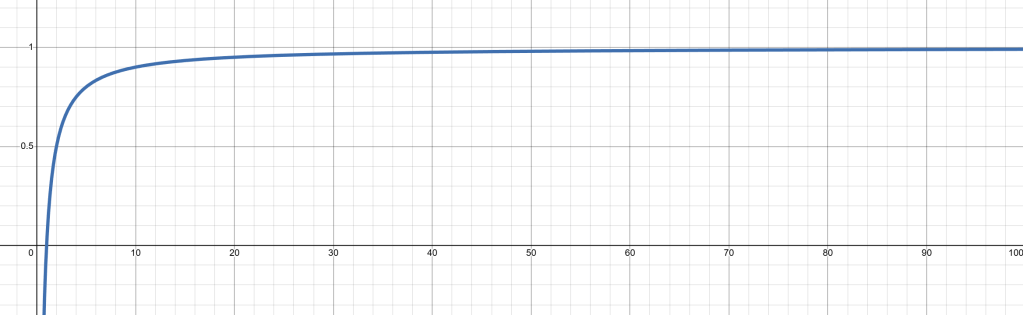
On the other hand, when (a_n) is bounded above we have a different situation. If we had a constant sequence, say (a_n) = (1), then it might not be too surprising that a_n \rightarrow 1. But, what if the sequence is actually increasing a_{n+1}> a_n for an infinite number of n? Well, think back to when you learned about asymptotes. Sometimes your increasing function is bounded by some value, usually called its asymptote. See below:

Here we have y = 1-\frac{1}{x}. Which is strictly increasing for all x and bounded above by 1.1 This is the exact same situation that we can find ourselves in! All we need to do is change the continuous function and its asymptote for a discrete sequence and a supremum.

But, for those who like more everyday examples, let’s consider a more physical analogy.

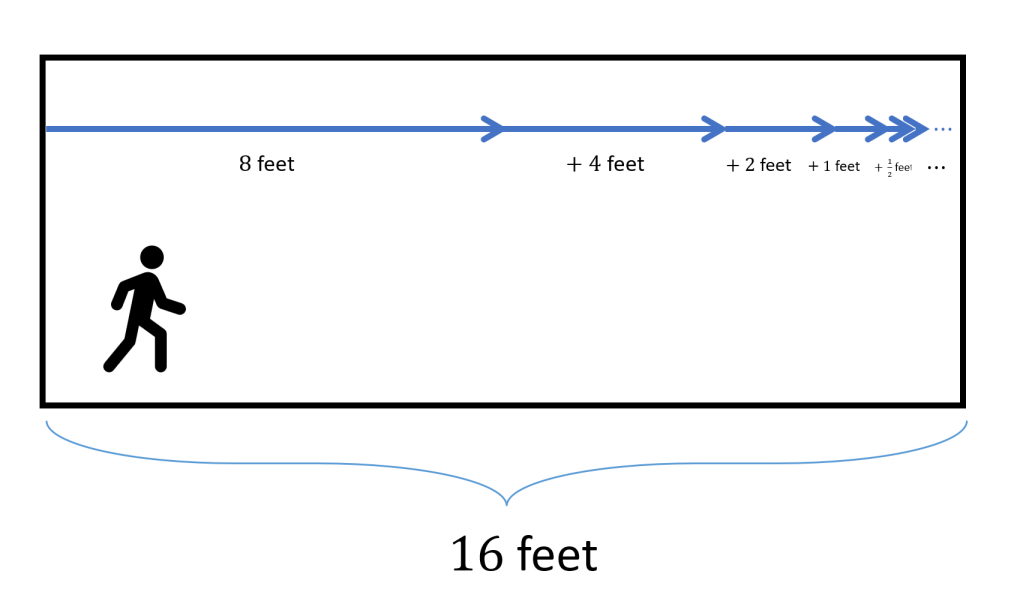
Imagine you are walking towards a wall that’s 16 feet in front of you. You will walk towards the wall in increments, our one rule is that during each increment you will move only half the distance to the wall. After the nth increment we denote the total distance you traveled so far by a_n.

  1. First, you start 16 feet away from the wall so you walk a_1 =8 feet towards the wall then pause, take a breath.
  2. Then, travel 4 feet closer to the wall (a_2 =12). Again, pause.
  3. Now move 2 feet closer to the wall (a_3 =14). Pause yet again.
  4. Then move 1 foot closer to the wall (a_4 =15).
  5. Then move \frac{1}{2} of a foot closer to the wall (a_5 =15\frac{1}{2}).
  6. Then, \frac{1}{4} of a foot closer to the wall ( a_6 =15\frac{3}{4} ).
  7. And so on and so on…
  8. In general, move \frac{8}{2^{n-1}} of a foot closer to the wall ( a_n = 8(2 - \frac{1}{2^{n-1}}) )2.

Let’s recap. You traveled 8 feet, then 8 + 4 = 12 feet, then 8 + 4 + 2 = 14 feet, then 8 + 4 + 2 + 1 = 15 feet, then 8 + 4 + 2 + 1 + \frac{1}{2} = 15.5 feet etc. In terms of (a_n) we have,

a_n\;:\;8\;,\;12\;,\;14\;,\;15\;,\;15.5\;,\;15.75\;,\;\cdots

Notice that you are always moving forward (a_n is monotone increasing) and since you are always traveling half the distance needed to reach the wall you never reach the wall, i.e. you are bounded by the wall (a_n \leq 16 for all n\in\mathbb{N}.).

However, you are slowly approaching a total travel distance of 16 feet. This is the exact same situation as some bounded monotone sequences! The elements of the sequence get closer and closer to their “wall” but never reach it. (Actually, sometimes they will reach the wall. This is like the constant sequence we mentioned earlier. But in those cases, it’s easier to see that they get stuck on, and converge to, their “wall” because they cannot take as step back since they are monotone increasing).

All we have to do is prove what we were just discussing. But, before we move on to the proof, I recommend you review the concepts/definitions of a supremum and an infimum from part 1. We use them heavily.

The Monotone Convergence Theorem


The Monotone Convergence Theorem (increasing case):

If you have a monotone increasing sequence a_n i.e. a_{n+1}\geq a_n , then

  1. when a_n is unbounded above the limit diverges to infinity a_n \rightarrow \infty, or
  2. when a_n is bounded above the limit exists and is finite: a_n \rightarrow \sup{\{a_n\;:\;n\in\mathbb{N}\}}.

The Monotone Convergence Theorem (decreasing case):

If you have a monotone decreasing sequence a_n i.e. a_{n+1}\leq a_n , then

  1. when a_n is unbounded below the limit diverges to negative infinity a_n \rightarrow -\infty, or
  2. when a_n is bounded below the limit exists and is finite: a_n \rightarrow \inf{\{a_n\;:\;n\in\mathbb{N}\}}.

Proof (Increasing Case): Let a_n be a monotone increasing sequence. We consider a case by case ,

(i) Let a_n be unbounded above.

Let M\in \mathbb{R}. There must exist an N\in\mathbb{N} such that a_n >M, for if there wasn’t then M would be an upper bound of a_n . Thus, a_n \rightarrow \infty.

(ii) Let a_n is bounded above, then we know by the least upper bound property that \sup{\{a_n\;:\;n\in\mathbb{N}\}} exists and is finite. We aim to show that a_n \rightarrow \sup{\{a_n\;:\;n\in\mathbb{N}\}}.

Let \varepsilon >0 and denote \alpha = \sup{\{a_n\;:\;n\in\mathbb{N}\}}. Because \alpha is a supremum, there must be some a_N\in \{a_n\;:\;n\in\mathbb{N}\} such that a_N > \alpha - \varepsilon. More than we know a_N \leq a_n \leq \alpha for all n>N. Thus,

\alpha - \varepsilon <a_N \leq a_n \leq \alpha < \alpha +\varepsilon

or better yet,

|a_n - \alpha| < \varepsilon,

showing that a_n \rightarrow \alpha.

\square

Proof (Increasing Case): Left as a CHALLENGE, put your proofs in the comments!

\square

Closing Remarks

Today was a short one! This is because I already have another two articles on examples that use the monotone convergence theorem, and I am lazy enough that I don’t want to write a new one! For those interested check out Incredibly Serious, Inductive Sequences and then A Strenuous Sequence mentioned at the start.

One last note, you might be surprised how useful this theorem is. We will see it again very soon so be as comfortable with it as you can!

As always, thank you for your time and effort reading this!

Footnote:

  1. Actually, 1 would be the supremum of the range of this function, i.e. \sup{\{y\in \mathbb{R}\;:\; y =  1-\frac{1}{x} \;\mathrm{for}\; x\in \mathbb{R} \;\mathrm{and}\;x>0\}} = 1. ↩︎
  2. We can see this by summing
    a_n = 8 + 4 + 2 + 1 + 1/2 + \cdots + 1/2^{n-4} =  8( 1 + 1/2 + 1/4 + \cdots + 1/2^{n-1}).
    If we let
    S =  1 + 1/2 + 1/4 + \cdots + 1/2^{n-1}
    then
    S/2 =  1/2 + 1/4 + 1/8 + \cdots 1/2^{n} .
    Subtracting S and S /2 gives,
    S - S/2 =S/2 = 1 - 1/2^{n}.
    Solving for S gives S =2 - \frac{1}{2^{n-1}}. Thus, a_n = 8S =  8(2 - \frac{1}{2^{n-1}}). Note, we can do this sort of algebraic manipulation because our sequence/sum is convergent. ↩︎

4 responses to “Let’s Get Real… Analysis (Part 5): the Monotone Convergence Theorem”

  1. What Happens When You Add Infinitely Many Numbers Together??? – A Kick in the Discovery Avatar

    […] of a sequence limit; however, I chose to use one of my favorite theorems from real analysis: the monotone convergence theorem. In order to use this theorem, we will define the sequence to be the partial […]

    Like

  2. Let’s Get Real… Analysis (Part 6): The Ratio Test for Sequences – A Kick in the Discovery Avatar

    […] having to do a proof by definition every time. Some of these tools are the Squeeze Theorem and the Monotone Convergence Theorem. Today, we will add another tool to our tool kit: the ratio […]

    Like

  3. Let’s Get Real… Analysis (Part 10): Cool Stuff with Cauchy Sequences – A Kick in the Discovery Avatar

    […] We’ve answered this question when is a monotone sequence, and the answer came in the form of the monotone convergence theorem. However, we don’t have a way to answer this question generally. This is our motivation for […]

    Like

  4. There are more Real Numbers than Counting Numbers! – A Kick in the Discovery Avatar

    […] Consider the sequence First, we note that is monotone increasing and bounded by By the monotone convergence theorem (which relies on the least upper bound property) we know that converges to Furthermore, every is […]

    Like

Leave a reply to Let’s Get Real… Analysis (Part 6): The Ratio Test for Sequences – A Kick in the Discovery Cancel reply