
We’ve asked and answered the question, “Can we ever prove that a sequence must converge without needing to know or find its limit beforehand?” in Let’s Get Real… Analysis (Part 5): The Monotone Convergence Theorem. Today, we will be proving something that has a similar flavor to that.
When I first saw what 

What are and ? (haha tiny math writing)
There’s no motivating this; here are the definitions:
Definition (Limit Superior): Let
be a bounded sequence and define the sequence
by
. If the limit exists, define
Similarly, define the limit inferior:
Definition (Limit Inferior): Let
. If the limit exists, define
***Note we may abbreviate these by
and
.***


These definitions are tricky to parse the first few (hundred) times you read them. Let’s go through some examples to try to help out!
Oh, and for some reason when I think of limSUPs I want to listen to the superman soundtrack… not sure why??? But in any case, here is the original Christopher Reeve Superman Theme and the new David Corenswet Superman Theme. Enjoy! Oh and my favorite superhero is Captain America!1
Graphical Example
For our first example, take a look at the following graph. The red dots are the elements of the sequence plotted against their index; that is, for the sequence 


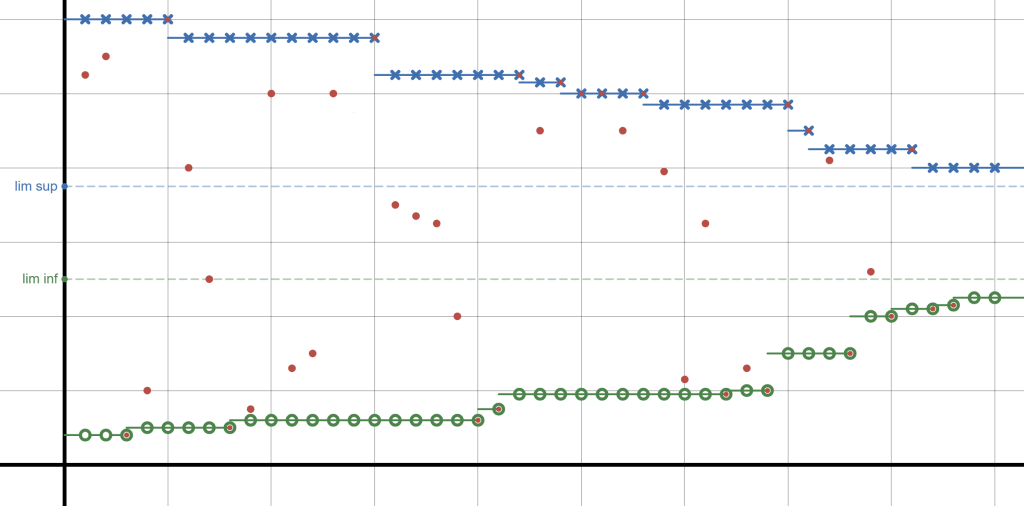
For example, the first five elements 

Take a few moments to understand what the picture is showing and then move on.
Once you find 


Example 1:
Consider the bounded sequence 

Which we can prove by noting that 


Continuing on to

which we have proved before here.
Finding

Which we can prove by noting that 


Let’s try another sequence!
Example 2:
Consider the bounded sequence 

I leave it for you to prove as a challenge (you’re welcome)! Continuing on to

Which is again, left as a challenge!
Turning our attention to

I leave it for you to prove as a challenge (again, you’re welcome)! Continuing on to

Which is again, left as a challenge!
Conjecture Time!
Take another look at the plot earlier; here it is again for convenience
What do you notice about the blue sequence 


The Monotone Convergence Theorem (increasing case):
If you have a monotone increasing sequence
i.e., then
- when
is unbounded above the limit diverges to infinity, or- when
is bounded above the limit exists and is finite:
The Monotone Convergence Theorem (decreasing case):
If you have a monotone decreasing sequence
i.e., then
- when
is unbounded below the limit diverges to negative infinity, or- when
is bounded below the limit exists and is finite:


So if
One last thing that we might notice is that 
Everything we observed is generally true, as summarized in the following theorem.
Theorem (LimSup and LimInf Properties): Let
- The sequence
.
- The sequence
.
- Lastly, we have the inequality
.
Proof: (Click in the Discovery)
Let
(i) First, let’s prove that 


By assumption 
(ii) Using part (i) and, guess what, the monotone convergence theorem
(iii) and (iv) Use a very similar argument to parts (i) and (ii).
(v) Note that 

Not too shabby so far! Good job keeping up with this stuff; it can be really tricky. Take a moment to pat yourself on the back, and when you are ready, we have one more theorem to prove.
Subsequences of
It might seem like there is no connection between 
Theorem (LimSup Subsequence and LimInf Subsequence ): Let
such that
Likewise, there exists a subsequence
such that


Scratch Work: We want to show that there exist such subsequences of
Let’s set up our conventional notation, let 


Let’s take stock of what we know about 

Moreover, since

Furthermore, since the above inequality holds for any 


So, so we want 


Then, for 


Likewise for 

And so on and so forth. This is the key idea to the following proof. We do change the definition slightly, but for reasons only for convince in defining 
Proof of limsup case: (Click in the Discovery)
We will construct a subsequence with the desired limit. We will define 
Let 


Now assume that 


Using this inductive definition, we note that 


It follows from our work with subsequences that 


Great working with you—until next time!
Limsups and liminfs are, in my opinion, very strange concepts upon first glance, but like many other topics in analysis (and math(s)) it is turns out to be very useful! Which is why it is covered in a course on analysis in the first place! Once thing that is amazing regarding the last theorem regarding limsups and liminfs is that it comes with a famous name. It’s called The Bolzano-Weierstrass Theorem:
The Bolzano-Weierstrass Theorem: Every bounded sequence
has a convergent subsequence

Proof: (Click in the Discovery)
Since 

My all-time favorite proof is the proof of the Bolzano-Weierstrass Theorem given in “Real Analysis: A Long-Form” by Jay Cummings. Highly highly recommend this book. I cannot recommend it enough. I provide a brief description of the book in the “Resources Worthy of Study” tab.
Good job today! You made it to the end, and you should be proud! Today we covered some advanced and challenging topics, and we made it to the end. I hope that yo uhad dun and learned alittle math along the way! Until next time!
Be Kind. Be Curious. Be Compassionate. Be Creative.
And Have Fun!
Footnotes:
- Here’s the Avengers theme for you hard core Marvel fans: The Avengers. ↩︎
- Theorem: (Proving Supremum using Analysis) Let
(i)
(ii) for any


 A Kick in the Discovery
Leave a comment